
Two years ago, Corbin Independent Schools faced a realization familiar to many districts: Students were not consistently demonstrating the mathematical practices necessary for deep understanding. Data from district “learning walks” revealed that classroom tasks didn’t always provide opportunities for students to engage in the math practice standards.
Rather than settling for a quick fix, the district asked “why” until they found the root cause. They discovered that while teachers wanted to support students, many lacked a concrete framework for what the eight (8) Effective Teaching Practices for Mathematics looked like in action.
“We realized the professional learning we had provided didn’t support the need teachers had,” said Sarah Watkins, chief academic officer. “So we stretched our one day PD we had scheduled for that summer and decided we wanted to provide a continual learning experience and support for teachers throughout the year.”
From “One and Done” to Job-Embedded Coaching
When the district flipped its approach to professional learning away from isolated summer sessions, Corbin Independent built a system of job-embedded coaching. Each month, teachers focused on a new math practice. Professional learning communities (PLCs) collectively rehearsed and prepared for lessons implementing that specific practice, then reflected as a team.
“When we flipped our idea of what professional learning was… with what high-quality professional learning should be—job-embedded time to rehearse, implement and reflect continually—we saw that sustained and continual learning that paralleled the student experience and included coaching support was how we would see change [in the student experience],” Watkins said.
To monitor the effectiveness of this new system, the district adopted the Kentucky Mathematics Innovation Tool (KMIT). The tool allowed leaders to see if the professional learning was transferring to the student experience and identify where teachers needed additional support. The data highlights clear growth at Corbin Primary between March 2024 and October 2025. During this period, scores for Math Teaching Practice (MTP) 6 improved from 0.77 to 1.10 and MTP 8 rose from 1.0 to 1.33.

HQIRs and Student Access
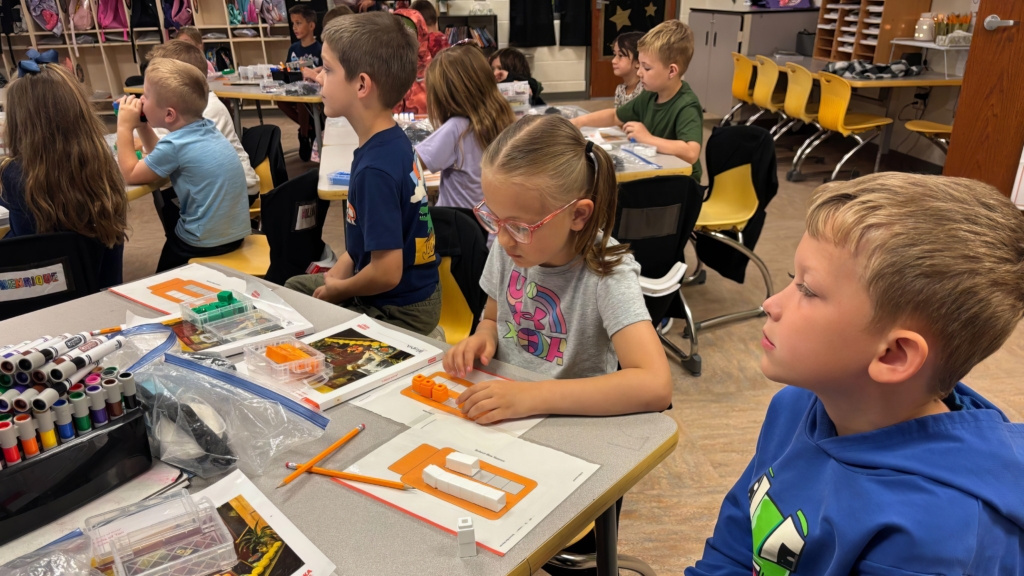
This focus on instructional practice is supported by high-quality instructional resources (HQIRs). In grades K-4, the district utilizes Eureka Squared. Watkins noted a “direct correlation” between classrooms using the HQIR effectively and those showing evidence of student mathematical practices.
The impact of a coherent curriculum has been profound regarding consistency and access to high-level instruction. “The biggest impact we’ve seen is [that] every classroom and every student is focused on grade-level standards,” Watkins explained. “And those teachers have seen the skills students are now coming to them with because of the coherence of the curriculum.”
Deepening Discourse and Culture
A major focus for the current school year is student discourse. While some classrooms utilize strategies from previous training, PLCs have taken ownership of solving the engagement puzzle. As teams internalize units, they discuss specific strategies to get students talking.
The most effective strategy has often been the simplest—the “turn and talk.” By giving students 30 seconds to think independently followed by 30 seconds to share with a partner, teachers are seeing increased success before moving to whole-group discussion.
This culture of collaboration extends to the teachers themselves. A leadership team of 10 teachers participating in the Kentucky Center for Mathematics Numeracy Counts Academy meets monthly to discuss best practices. This group recently initiated peer observations using the KMIT tool, visiting one another’s classrooms to observe a single practice and discuss strengths. Administration is mirroring this commitment, with three principals and one district administrator participating in the PIMSER Numeracy Counts Administrator Academy this year.
Outcomes: Rigor and Reduced Intervention
The shift in professional learning and curriculum has yielded dramatic results. Comparing 2022-23 data to 2024-25, every school that utilized coaching increased their Proficient/Distinguished (P/D) math KSA scores. Corbin Primary saw a 14% increase in P/D, Corbin High rose 8%, Corbin Elementary increased 5% and Corbin Middle saw a 2% gain. Following the pandemic, intervention numbers were overwhelming. Today, the landscape looks different. “Our numbers for interventions have dramatically declined,” Watkins said. “Now we have students needing intervention by their fifth-grade year down to a single digit some years!”
Beyond the data, the students’ relationship with math has changed. Watkins notes that rigor is the greatest impact, with students leaving primary school possessing the “grit and endurance needed to tackle rigorous tasks.”
In Closing
By aligning professional learning, resource selection and monitoring tools, Corbin Independent has built a math ecosystem where teachers feel supported, and students are prepared to persevere.